Dholki & Mayun Invitations for the Nights Before the Wedding
What are Dholki and Mayun, and how are they different?
Mayun and Dholki both happen in the run-up to the wedding and are often confused, but they are not the same thing. Mayun is a specific ritual: the bride (and in some families the groom) is seated in yellow while female relatives apply ubtan, a paste of turmeric, gram flour and fragrant oils, and traditionally she stays at home from then until the wedding. It is usually a small, family-only gathering. Dholki is the informal singing-and-drumming get-together held in the weeks before the wedding, at different relatives' homes and on different evenings, built around the dholak, folk songs and chai. There is often more than one Dholki, and no single "the" Dholki night the way there is one Baraat.
Because both are intimate and family-led, the dress code is relaxed: yellow and green suit a Mayun, while a Dholki has no fixed colour. The hosts are usually the bride's or groom's immediate family, and the setting is more often a home than a rented venue.
Wording notes
Dholki and Mayun invitations read warm and casual, closer to a family message than a formal card, because that is what they have always been. Say who is hosting (an aunt's house is common), what to expect (dholak, songs, chai), and whether it is the Mayun itself, which needs the ubtan and the yellow, or an open Dholki evening.
How Niru handles Dholki and Mayun invitations
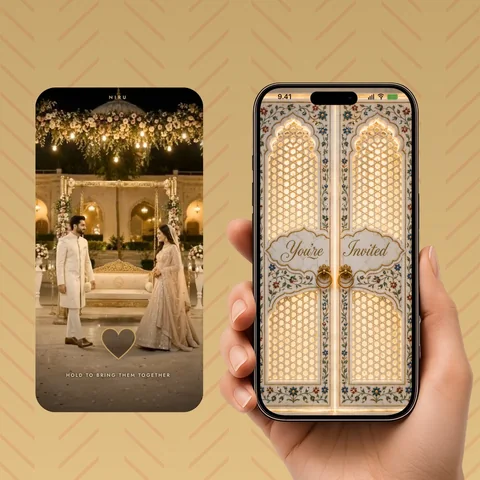
Dholki and Mayun rarely got a printed card at all; they were a phone call or a message in the family group. Inside a Niru invitation they get the same care as the Baraat or Walima: their own section with the date, the address and a map, and the dress code, without a separate printed card that would feel oddly formal for something this intimate.
Because a Dholki can happen more than once, at more than one house, tell us every gathering when you order and each one is added with its own host, address and time. Guests reply for the gatherings they are coming to, so each host knows roughly how many to expect without anyone counting replies in a WhatsApp thread.
Sample Dholki and Mayun wording
Turmeric, yellow and the whole family in one room.The Mayun of Danyal, hosted by his parents.Sunday, 6th December · 5:00 pm · At home
Dholak nights don't really need an invitation, but here is one anyway.Come and sing with us before Danyal & Mahnoor's wedding.Dholki · Thursday, 3rd December · 7:30 pm
Urdu version:
دانیال کا مایوں، پیلا رنگ، ابٹن اور گھر بھر کی رونق، آپ کی شرکت سے یہ شام مکمل ہوگی۔اتوار، 6 دسمبر، شام 5 بجے، گھر پر
Which Niru designs suit a Dholki or Mayun?
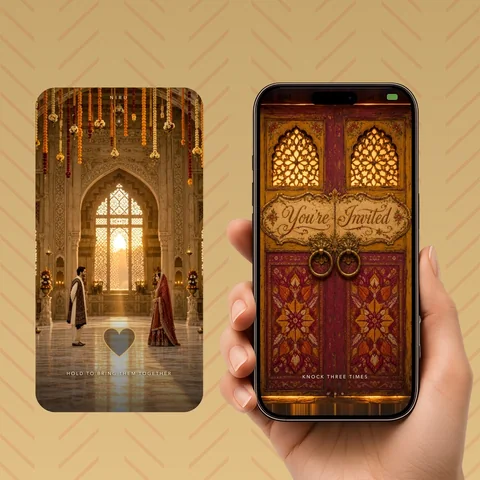
- Aangan carries the Mayun, Nikah and Walima, opening onto a Bahawalpur courtyard at night with a jhoola hung with roses. Its marble and blush palette suits an intimate family gathering.
- Ajrak names the Dholki among its occasions, block-printed in indigo and madder with sheesha mirror work: a folk register that suits a dholak evening.
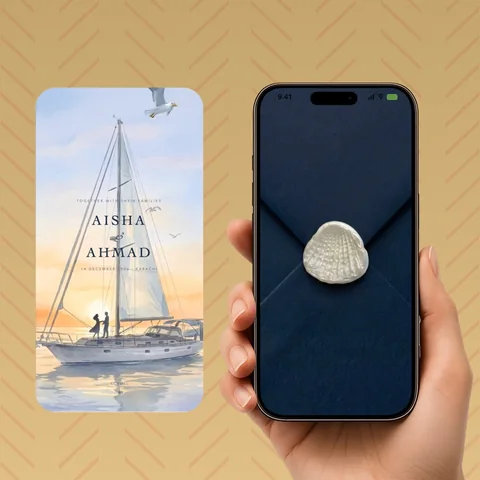
- Saahil carries the Mayun alongside the Mehndi, Baraat and Walima for a wedding by the water in Karachi, gentle rather than grand.
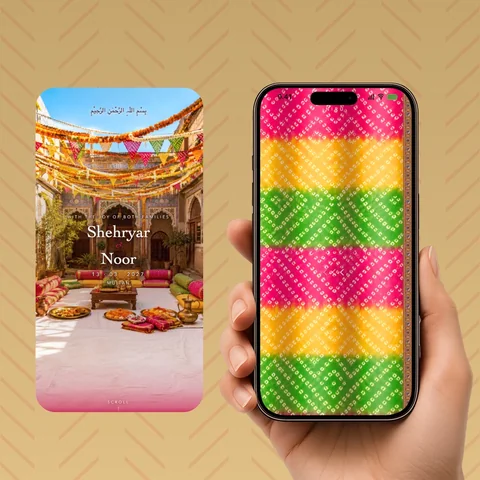
- Chunri is the bright one: a bandhani chunri drawn aside onto a haveli courtyard, as informal and colourful as a Dholki night.
What it costs
Dholki and Mayun are included in every Niru tier at no extra cost: Signature at PKR 5,900, Premium at PKR 8,400, Atelier at PKR 12,490. These are founding prices for our first 50 couples; after that, the regular prices apply. If one gathering has a genuinely separate guest list, say a Dholki only at the bride's aunt's house, a separate guest-list link for it is PKR 1,500. See every design or read the price guide.