Urdu Wedding Invitations, Written as Urdu and Not Translated
What is an Urdu wedding invitation on Niru?
Every Niru invitation carries English and Urdu in the same card, and each guest switches between them with one tap: no second link and no second design. For many Pakistani families that one tap solves a real problem. The grandparent who wants to read the invitation in Urdu and the cousin abroad who is more comfortable in English open exactly the same card.
The Urdu is set in Nastaliq, the calligraphic script Urdu is actually written in, not a flat Naskh substitute that looks like Arabic on a website. And the Urdu text is composed as Urdu, not translated line by line from the English draft, so it reads the way a family would write it.
Families who read Urdu, and families who read English
On most guest lists this is not a clean split by generation; it is mixed within the same household. A father may prefer Urdu and his children English; an uncle abroad may only read English. A printed card forced a choice: one language, on paper, for everyone. A digital invitation doesn't have to. The switch lives on the card, so you don't decide in advance who gets which version. Every guest decides for themselves.
Nastaliq, not just "Urdu script"
Type matters more on a wedding card than almost anywhere else: it is the first thing every guest reads, on a phone, at a glance. Nastaliq is harder to set well on screen than most scripts. It needs generous line height, room for its diagonal flow, and a size that doesn't clip its loops. Niru's cards are built with that in mind, so the Urdu side is designed with the same care as the English rather than squeezed in beside it.
One tap between English and Urdu
The language switch sits on the card itself. Open the invitation, tap once, and the whole card changes language: the headings, the function names, the dates, the RSVP form. It is a small mechanism, but it is the difference between an invitation that serves one side of the family and one that serves everyone on the list.
Getting the wording right
Pakistani invitations carry more structure than a typical English card: the host families are named, the guest's presence is requested formally, the couple is named with their parentage, and the function names (Mehndi, Baraat, Nikah, Walima, Mayun or a Qawwali night) stay in their own words rather than being translated into something generic. Niru writes both sides to match. The English carries the formality Pakistani stationery expects, and the Urdu is written the way the sentiment is actually spoken, including the few English words people naturally use in Urdu, rather than mirroring the English sentence by sentence.
If you are drafting your own wording before you order, the wedding invitation wording guide has examples for every function in both languages.
A sample invitation in both languages
English
With the blessings of both families,Ibrahim & Haniarequest the honour of your presenceat their Nikah and Walima.
Urdu
دونوں خاندانوں کی دعاؤں کے ساتھابراہیم اور حانیہاپنے نکاح اور ولیمے کی تقریبات میںآپ کی شرکت کے منتظر ہیں۔
The Urdu is not a word-for-word rendering of the English. "Request the honour of your presence" becomes "آپ کی شرکت کے منتظر ہیں", which is how the sentiment is naturally written in Urdu.
Choose a design for your Urdu invitation
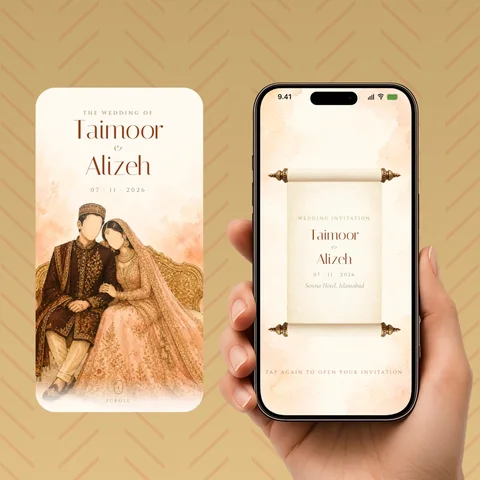
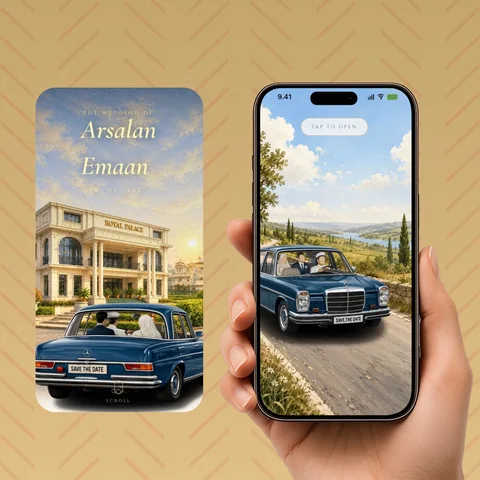
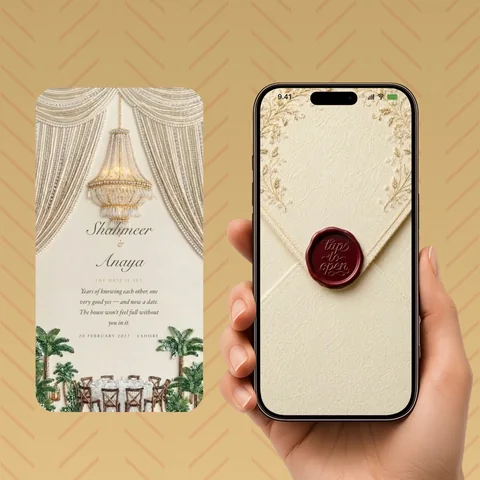
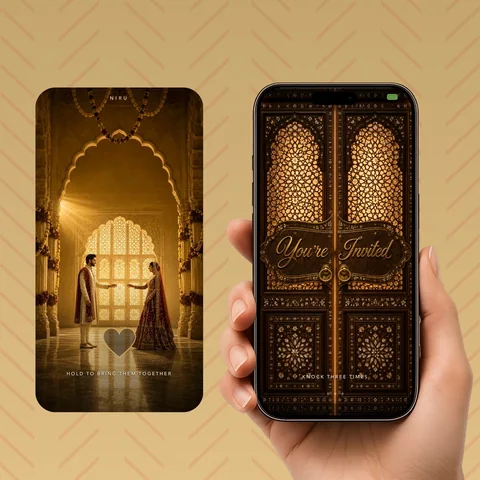
All 24 live designs are bilingual; there is no separate "Urdu version" to choose. Farmaan is built around a royal decree and its calligraphy; Dilkusha names both families with their grandparents; Qasr and Dehleez open on a threshold that suits families who want the Urdu side to feel formal from the first tap. Browse all designs and open any live demo in Urdu to see the Nastaliq for yourself before you order.