Pakistani Wedding Functions Explained: Mayun to Walima, in Order
A typical Pakistani wedding runs across three to five functions in this order: Mayun and Dholki (the pre-wedding rituals and informal music nights), the Mehndi (the colourful pre-wedding celebration), the Baraat and Nikah (the groom's procession and the marriage contract, usually on the same day, followed by the Rukhsati), and the Walima (the reception hosted by the groom's family). Not every family holds all of them; many fold the Mayun into the Mehndi, or hold just the Mehndi, the Baraat & Nikah and the Walima. But this is the sequence guests and vendors expect by default.
Mayun and Dholki
What happens: At the Mayun, the bride is seated in yellow and female relatives apply ubtan, a paste of turmeric and gram flour, in the days before the wedding. In many families she then stays at home until the wedding. A Dholki is an informal evening of singing and dholak in the weeks before, at either family's home, casual and come-and-go.
Who hosts: Usually the bride's mother and close female relatives for the Mayun; a Dholki can be at either house, and there are often several.
When: The Mayun is usually a few days to a week before the main functions; Dholkis happen through the weeks before.
What to wear: Yellow and green for the Mayun; bright, casual traditional wear for a Dholki.
On the invitation: These are close-family gatherings and often don't get a formal card at all. When they do, keep the tone warm and informal. See Dholki and Mayun invitations.
Mehndi
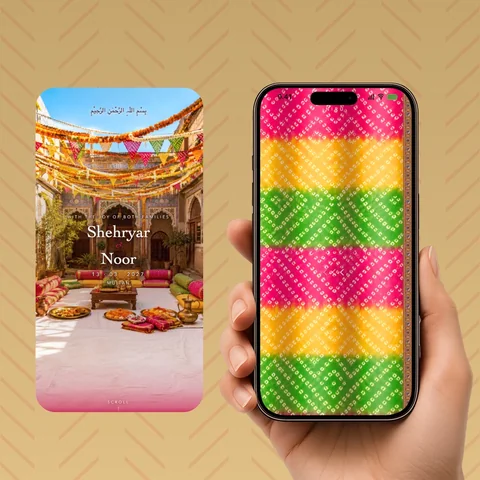
What happens: Henna for the bride (and in many families the groom), dance performances prepared by friends and cousins, dhol, songs and bright decor.
Who hosts: Either side, or both together. Some families hold a separate Mehndi for each side on different nights; others share one evening.
When: Usually one or two nights before the Baraat.
What to wear: Bright colours: yellow, green, orange, pink. Many families ask guests to avoid black and white.
On the invitation: This is the one function where the wording can be playful. See Mehndi invitations.
Baraat
What happens: The groom's procession arrives at the venue with his family and friends, often with a dhol. In everyday use, "Baraat" also means the whole wedding-day function.
Who hosts: Traditionally the bride's family, since it is her wedding day, though hosting is often shared.
When: Usually the same evening as the Nikah; the Rukhsati, when the bride leaves her parents' home, closes the night.
What to wear: The most formal function of the set: heavier, embroidered outfits. Brides often wear red, though colour varies by region and personal choice.
On the invitation: Be explicit about Baraat and Nikah times, because guests plan around the arrival. See Baraat invitations.
Nikah
What happens: The Islamic marriage contract. The Nikah Khwan conducts the ceremony, the bride and groom give their consent, witnesses sign, and the mehr is agreed and recorded.
Who hosts: It depends on the family. Many hold it on the Baraat evening; others hold it earlier in the day, or days or weeks before, as a small gathering.
What to wear: Modest, and often simpler than the Baraat outfit when it is held separately.
On the invitation: If the Nikah is separate from the Baraat, give it its own date and time so guests never have to guess which one "the wedding" means. See Nikah invitations.
Walima
What happens: The reception after the wedding, hosted by the groom's family, introducing the couple as husband and wife to the wider circle. Dinner is served.
Who hosts: The groom's family, by convention.
When: Usually one to three days after the Baraat and Nikah.
What to wear: Formal; the bride usually wears a different, often lighter-coloured outfit from the Baraat.
On the invitation: Say that dinner will be served, and repeat the venue and time rather than assuming guests remember them. See Walima invitations.
How it varies across Pakistan
These functions are common across Pakistan, but their emphasis, timing and extra rituals vary by region, community and family, and many families mix traditions freely. Some broad patterns:
- In many Punjabi families the Mehndi is the biggest, loudest night, sometimes held separately by each side, with the Mayun folded into it.
- Sindhi families often keep their own pre-wedding rituals and may hold the Nikah as a distinct ceremony before the main celebration.
- Many Pashtun families keep segregated seating at every function, not only the Nikah, and place great weight on hospitality.
- Kashmiri families may hold their own henna night and other pre-wedding customs alongside the Mehndi.
- Urdu-speaking families often keep a formal style of card and hosting etiquette, and may hold a Mangni (engagement) well before the wedding.
None of this is fixed. A family's own customs matter more than any regional pattern, and the best source is always your own elders.
Getting the order right on the invitation
Because guests are often invited to only some functions, the invitation has to be explicit about which ones apply. A digital invitation makes this easier than a single printed card: a Niru card gives each function its own section with its own date, time, venue, map and dress code, and a separate guest-list link can show a Walima-only guest just the Walima.
For wording that fits each function, see the wedding invitation wording guide. To send it well, see how to send wedding invitations on WhatsApp.